The Freezer Inventory System: Never Lose a Meal to the Back of the Freezer Again
This post may contain affiliate links. If you buy through them, I may earn a small commission at no extra cost to you.
What You’ll Need
- Gallon freezer bags — the workhorse of freezer cooking
- FoodSaver vacuum sealer — prevents freezer burn, keeps food fresh 5x longer
Introduction
Every freezer has a back corner where good intentions go to frost over. A bag of something brown and unidentifiable. Soup from a month you cannot name. Chicken bought on sale, buried under three newer bags of chicken, discovered only after it turned dry and freezer-burned. That is not a storage problem — it is an information problem. The food was fine. You just could not see it, name it, or remember it in time.
The cost is real money. A tossed casserole, a ruined pack of chicken, a duplicate bag of ground beef bought because the first one was invisible — it adds up fast, and it undermines the whole point of freezer cooking. You did the work in sessions like The 2-Hour Freezer Prep Session: 10 Dinners, One Shopping List so dinner would be handled. A meal nobody can find is a meal that never happens.
This post is the fix, and it is deliberately simple: a five-part system built around one master inventory list, a label on everything, zones and bins so every meal has an address, first-in-first-out rotation, and a 10-minute monthly check. No app purchase, no spreadsheet empire, nothing you will abandon by February. If you are new to freezer cooking, Beginner’s Guide: How to Start Freezer Cooking covers the cooking basics; this system is the organization layer on top of it.

1. Start With a Reset: Empty, Sort, and Count What You Have
You cannot inventory a freezer you have never fully seen, so the system starts with one honest reset. Pick a day when the freezer is at its fullest-typical, not its emptiest. Pull everything out onto the counter, working fast and grouping as you go — a full freezer’s worth of food is safe on the counter for the 20–30 minutes this takes, and a cooler with ice packs buys you extra time if you want it.
Sort into four piles. Keep and use soon: good food, recently frozen, clearly identifiable. Keep: good food with plenty of quality time left. Cook this week: the oldest good items, partial bags, and anything approaching its best-quality window — these become this week’s dinners, not next month’s regrets. Toss: anything you cannot identify, anything heavily freezer-burned, and anything that thawed and refroze during a power outage. When in doubt about identity, throw it out — an unidentifiable item is one you were never going to cook on purpose.
While everything is out, wipe the shelves, check the thermometer (0°F or below), and count what goes back in, category by category: how many chicken meals, how many soups, how many pounds of ground beef. That count is the first draft of your inventory list — write it down at the counter, not from memory later. Then load the food back using the zones in Section 4, oldest items toward the front. The reset takes under an hour, you only do it once, and most people find at least two “free” dinners they had forgotten they owned.

2. The Master Inventory List (Paper, Whiteboard, or Spreadsheet)
The inventory list is the heart of the system: one running record of what is in the freezer, kept where you will actually see it. Format matters far less than location and habit. A small whiteboard or magnetic notepad on the freezer door works for most families — visible at the exact moment food goes in or out. A spreadsheet or phone note works too, if you will truly open it: a perfect spreadsheet nobody opens loses to a scruffy door list every time.
Whatever the format, keep the columns the same. Each line gets five things:
| Item | Qty | Frozen on | Use by | Zone |
|---|---|---|---|---|
| Chicken tortilla soup | 2 bags | Oct 3 | Dec 3 | Soups |
| Ground beef, 1 lb packs | 4 | Oct 10 | Jan 10 | Raw meat |
| Slow cooker salsa chicken | 1 bag | Sep 22 | Nov 22 | Eat First |
| Blueberry oatmeal cups | 6 | Oct 15 | Jan 15 | Breakfast |
Three habits keep the list alive. Add a line the moment food goes in — before the freezer door closes, not at the end of the day. Cross off, don’t erase, when food comes out: a crossed-out line still tells you what you have been eating and what to make again. Record quantities, not just items — “chicken soup” is trivia, “chicken soup × 2” is a plan, because the second bag is exactly the one that gets lost. When you cook from sessions like 15 Slow Cooker Dump Meals, add all the bags in one go while they are lined up on the counter; it takes ninety seconds and saves the whole batch from going invisible.

3. The Label System: Name It, Date It, Give It a Deadline
If the inventory is the map, the label is the road sign — and the rule is absolute: nothing enters the freezer without one. An unlabeled bag becomes a mystery bag within a month, because frozen food all converges on the same frosty, amber-colored look. Chili, spaghetti sauce, and beef stew are indistinguishable at 0°F, and “I’ll remember” has a perfect record of being wrong.
Every label gets four things, in this order:
- The full name — not “soup,” but “chicken tortilla soup.” Future-you needs the specific dish.
- The date frozen — month and day is enough (“Oct 3”).
- The use-by deadline — the date frozen plus that food’s best-quality window from the chart below (“use by Dec 3”). This is the line most labels miss, and it does the work: it turns a vague someday into a decision you can read at a glance.
- Anything cooking day needs — servings (“serves 4”), raw or cooked, and add-later notes (“add sour cream fresh,” “thaw overnight, slow cooker LOW 4 hrs”).
Tools are simple. A permanent marker straight on the bag is fastest — write on a dry, flat bag before filling it, or on the label panel many freezer bags provide. Freezer tape or dissolvable labels suit containers. Colored dot stickers are a cheap upgrade: one color per category (red for raw meat, blue for cooked meals, green for vegetables) lets you read the freezer at a glance. Label flat bags on the wide face and store them with the label edge facing out — Section 5 shows why that detail makes rotation effortless.

4. Zones and Bins: Give Every Meal an Address
A list tells you a meal exists. A zone tells you where it lives. Divide your freezer into a handful of fixed zones — the same categories every time, matched to how your family actually eats — and every item gets exactly one home:
- Raw meat and seafood — bottom shelf or back basket, so nothing can drip onto cooked food, and raw proteins stay together.
- Cooked freezer meals — the dinners themselves: casseroles, soups, dump bags, marinated chicken. This is most families’ biggest zone.
- Vegetables and fruit — bags of frozen vegetables, fruit for smoothies and baking.
- Breakfasts and breads — burritos, oatmeal cups, waffles, sliced bread, tortillas.
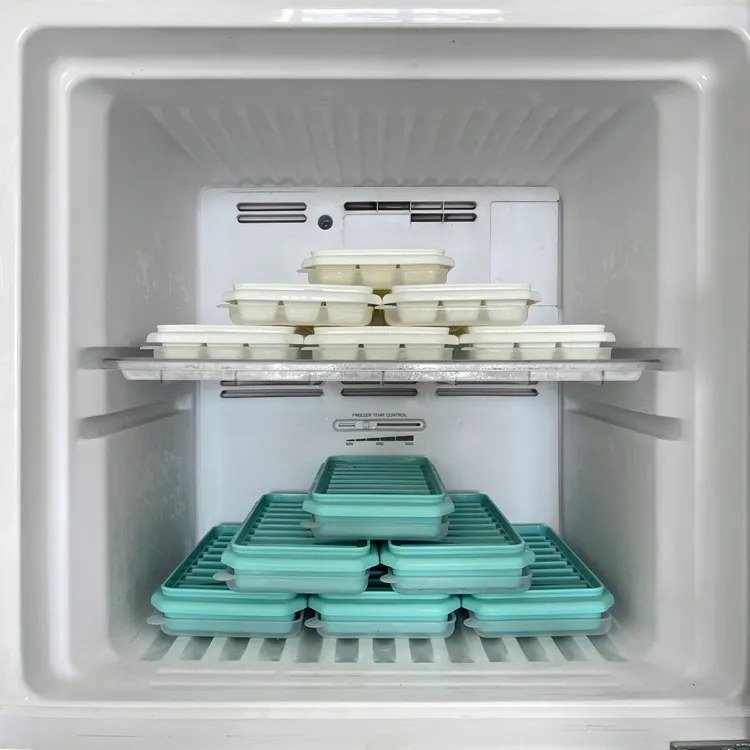
- Small things — a single small bin for the items that vanish: stock cubes, herb pucks, tomato paste portions, grated cheese, lemon juice cubes.
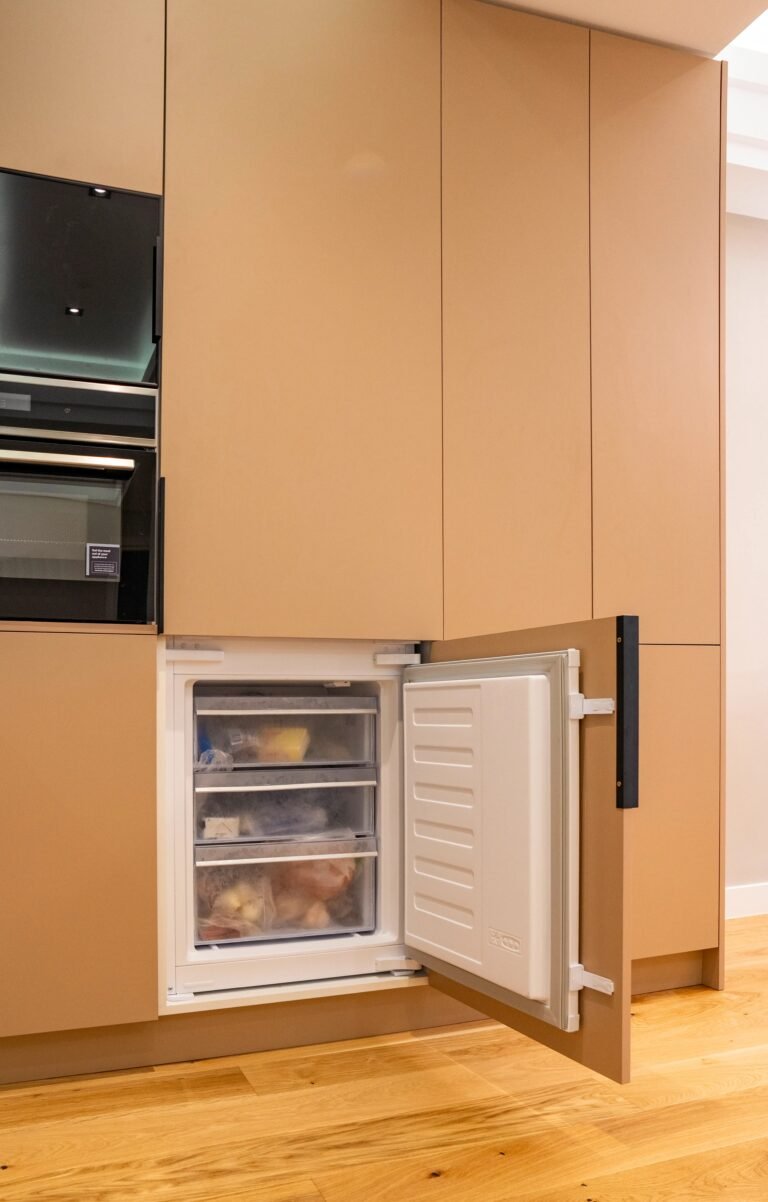
Bins are what make zones survive real life. In an upright or drawer freezer, one open-top bin per zone keeps bags from avalanching and lets you pull a whole category out to browse it. In a chest freezer, bins and sturdy reusable grocery bags are essential — they are the only thing standing between you and a bottom layer nobody has seen since spring; assign one bag per category and lift it out whole. Freeze bags flat, then file them upright in their bin like envelopes once solid: you can flip through a week’s dinners in seconds, labels facing you, instead of digging. Finally, write each item’s zone on the inventory list (that fifth column in Section 2). “Salsa chicken — Cooked meals bin” means anyone in the house can find dinner, not just the person who froze it.

5. FIFO Rotation: First In, First Out, Every Time
FIFO is the grocery-store rule that keeps this system honest: first in, first out — the oldest food gets eaten first, always. Without it, the natural move — new bags on top, grab whatever is on top — means the newest food gets eaten while the oldest sinks, ages, and gets thrown away. FIFO reverses that with two physical habits.
New goes behind, under, or to the back. When a fresh batch goes in, it never lands on top of its older siblings. New soup bags slide behind or beneath the soup already there; new chicken goes to the back of the raw-meat zone. Dinner comes from the front. Whatever your hand meets first in each zone is, by design, the oldest — so “grab the front bag” and “eat the oldest first” become the same action, and nobody has to check a date before choosing.
The flat-file system from Section 4 makes this almost automatic: filed bags rotate like a card catalog, new files at the back, meals pulled from the front. For containers, stack newest on the bottom. Your inventory list backs the system up — it is roughly chronological within each category, so the top lines of each group are your oldest stock. A quick example: you froze salsa chicken on September 22 and a second batch on October 20. In November, the September bag is dinner, even though both are “fine.” That one decision, repeated all year, is the difference between a freezer that rotates and a freezer that archives. Families who prep for two get extra protection from this — 11 Freezer Meals for Two: No Endless Leftovers portions small on purpose, and FIFO makes sure those smaller bags cycle instead of stacking up.

6. The “Eat First” Box
The Eat First box is the system’s pressure valve: one small bin, box, or clearly marked bag that lives at the front of the cooked-meals zone and holds whatever needs eating soonest. Into it goes anything approaching its use-by deadline, the last portion of a batch, a partial bag of vegetables, the soup you froze six weeks ago, leftovers you froze on a whim. Nothing in the box is bad — it is simply next in line, and it has been promoted to the front so it wins.
Run it with three rules. Capacity is small on purpose — a shoebox-size bin, not a shelf; a big box becomes a second junk drawer. The box feeds the meal plan first. When you plan the week, start by looking in the Eat First box and building two or three dinners around it — add a starch, a vegetable, or a salad and most contents become a complete meal. Refill it at the monthly check (next section) and whenever a deadline approaches — moving an item into the box takes five seconds and is the highest-value habit in this article.
The box ends the most wasteful freezer pattern: cooking something new while something good ages out two inches away. Every dinner from the Eat First box is money rescued — the same principle behind 9 Freezer Meals Under $3 a Serving, where the cheapest meal is the one you already paid for.

7. The 10-Minute Monthly Check and Shopping Your Freezer First
Systems do not fail in a day; they drift. The monthly check is ten minutes, once a month — tie it to something you already do, like the first Sunday coffee — that pulls everything back into line.
- Reconcile the list (3 minutes). Stand at the open freezer with the inventory. Anything in the freezer but not on the list gets added; anything on the list but not in the freezer gets crossed off.
- Promote the urgent (3 minutes). Anything within a month of its use-by date moves into the Eat First box. Anything past its best-quality window but still frozen solid and sound goes to the top of that box, planned for this week.
- Straighten the zones (2 minutes). Bags that landed in the wrong home get re-filed, oldest to the front. If one zone overflows and another is empty, that is information for your next prep session — you do not need more of the full one.
- Shop your freezer first (2 minutes). Before any grocery list gets written, read the inventory like a store flyer. Three chicken meals, two soups, and a bag of ground beef already paid for means this week’s list is produce, dairy, and pantry gaps — not more chicken. Batches like 12 Chicken Freezer Meals You Can Prep in One Hour should only happen when the list says chicken is actually low.
That is the whole maintenance burden of the system: ten minutes a month, in exchange for a freezer where every meal is findable, labeled, dated, and eaten at its best.

How Long Do Foods Keep in the Freezer?
Keep your freezer at 0°F or below and food stays safe while it is frozen solid — freezing stops bacteria; it does not kill them, and the times below are about best quality (flavor, texture, moisture), not safety deadlines. The label deadline from Section 3 comes straight from this list:
- Whole chicken or turkey: 12 months
- Chicken or turkey pieces: 9 months
- Beef steaks and roasts: 6–12 months
- Pork chops and roasts: 4–6 months
- Ground meat and ground poultry: 3–4 months
- Cooked meals, casseroles, and meat dishes: 2–3 months
- Soups and stews: 2–3 months
- Lean fish (cod, tilapia): 6–8 months; fatty fish (salmon): 2–3 months
- Vegetables (blanched): 8–12 months; fruit: 8–12 months
- Bread and baked goods: 2–3 months; butter: 6–9 months; hard cheese: about 6 months
Thaw safely: in the fridge overnight (best), in cold water changed every 30 minutes, or in the microwave — never on the counter. Food thawed in the fridge can be refrozen within a day or two, with some quality loss; food thawed on the counter cannot.
Frequently Asked Questions
What should go on a freezer inventory list?
Five things per item: the full name of the food, the quantity, the date it was frozen, its use-by date (frozen date plus its best-quality window), and where it lives — the zone or bin. Keep the list on the freezer door, a whiteboard, a notepad, or in a spreadsheet, add a line the moment food goes in, and cross items off as they come out.
How long does food last in the freezer?
For best quality at 0°F: whole chicken 12 months, chicken pieces 9 months, steaks and roasts 6–12 months, ground meat 3–4 months, cooked meals and soups 2–3 months, most vegetables 8–12 months. Those numbers protect flavor and texture — food kept frozen solid stays safe beyond them, it just gradually dries out and loses quality.
Is it safe to eat food that has been in the freezer longer than the recommended time?
Generally yes. Food held continuously at 0°F remains safe indefinitely; the recommended times mark declining quality, not a safety cutoff. A chicken breast frozen for 14 months will not make you sick, but it will likely be dry and bland. Discard food that thawed during a long outage, sat out before freezing, or smells off after thawing, regardless of dates.
Can you refreeze meat that has already been thawed?
Yes, if it thawed in the refrigerator and stayed at or below 40°F — refreeze within 1–2 days, expecting some texture loss. You can also cook thawed meat and freeze the cooked dish. Never refreeze meat that thawed on the counter or in warm water.
What temperature should a home freezer be set to?
0°F (-18°C) or below — the USDA standard, and the temperature all the storage times in this article assume. Many freezers run a few degrees warmer than their dial claims, especially older ones and door-heavy refrigerator freezers, so check yours with an inexpensive appliance thermometer and adjust until it reads 0°F.
Why does freezer burn happen, and is freezer-burned food safe to eat?
Freezer burn is moisture escaping from the food’s surface, leaving gray-white, dry, leathery patches. It is a quality problem, not a safety one — the burned spots taste dry and bland, but the rest of the food is fine; trim the worst patches before cooking. Prevent it with airtight packaging and as little air as possible: press air out of bags, freeze flat, wrap tightly.
Conclusion
A working freezer is not a bigger one — it is a freezer you can read. One reset, one list on the door, a real label on every bag, a zone for everything, oldest-first rotation, an Eat First box, and ten minutes a month. Together they mean no mystery bags, no duplicate buying, and no good dinner quietly expiring at the back.
Start this weekend with the reset and the door list — the two steps that make every other step easy — and let the first Eat First dinner be the meal you rescued.
This is the freezer post worth keeping: Pin it and save it for your next prep session — and send it to anyone whose freezer is currently hiding dinner from them.